"The church is like an army. It lives by conquest. When conquest ceases, mutiny begins."
Remember Who You Are
"The people need someone to remind them who they are." I first heard this line in an old western movie. The hero of the film, an aged indian chief, worked to keep the indigenous people tied to their ancient culture. And it proved a difficult task as waves of settlers moved into their countryside.
"The people need someone to remind them who they are," is applicable not only to Native Americans but also to Christians. Like the Native Americans who were losing touch with their culture, Christians need to stay rooted to their true spiritual identity as outlined in scripture.
Consider the following truths all Christians must remember:
- I am no longer a slave, I am a son
- I once was far away, but now I am brought near to God
- Old things have passed away, behold all things have become new
- I was enslaved, but now I am free
- I was defeated, but now I am an overcomer
- I was in darkness, but now I am in the Light
- I was a lawbreaker, but now I am justified
- I am not going to hell, I am going to heaven
- I was an alien, but now I am adopted
- I was poor, but now I am rich, a co-heir with Christ
- I was guilty, but now I am declared righteous in Christ
- I was dead, now I am born again
Live up to your true identity. Remember who you are in Christ.
Discipleship to Young Men
When I wrote my book "Discipleship Matters" God led me to aim it at young men. And indeed it has worked well with that demographic. Since publication I have led numerous young men through the book and it has been a rewarding experience. Dr. Robby Gallaty says it is probable that the Twelve Apostles were teenagers. His seven reasons are as follows:
- Jesus used Greek words that suggest the disciples were young. See Matthew 10:42 "little ones" (mikros) and John 13:33 "little children" (teknion).
- According to the Mishna, Jewish boys were schooled on a particular schedule. During their teen years of education it would have been more likely for them to go follow a Rabbi.
- Marital status. The only disciple we know who was married was Peter. Jesus healed his mother-in-law. The others were probably not married because they were under the age of eighteen.
- The Temple Tax is mentioned in Matthew 17:24. Exodus 30 says every Jewish man twenty years of age and older had to pay the Temple Tax. The only disciple who had to pay the tax was Peter.
- Traveling. It would have been highly unlikedly for married men to leave their families and follow Jesus. It would have been easier for teenagers.
- Longevity. Based on the dating of the book of Revelation, we know John lived until the late first century, therefore he must have been young when Jesus called him.
- Immaturity. The disciples being young and immature were unable to understand theological concepts, unaware that a devil was among them, willing to call down fire from heaven on their enemies, argued about greatness, and put their mother up to ask the Master for preferred seating.
Mark Clifton has written "Reclaiming Glory: Revitalizing Dying Churches." Mark is widely seen as an expert in the field of church revitalization. In his book he mentions six imperatives for congregational renewal, one of which is focus on reaching young men. He properly notes that a dying church never says, "We have too many young men around here. We need to attract some older adults." But obviously all of us in church work have seen the opposite.
How fascinating. Jesus reached young men and Clifton says young men are the key to church revitalization. I know where I want to keep spending my time and energy. How about you?
Distractions to Worship
Mary consistently worshiped Jesus. She is seen at the feet of Jesus near the beginning and the end of His earthly ministry. What a remarkable woman to learn from. She worshiped Jesus despite the distractions that tried to pull her away from the Lord. Today we battle the same distractions.
THERE IS THE DISTRACTION OF THINGS
Luke 10 describes meal preparation led by Mary's sister, Martha. Can you hear the clanking of the pots and pans? Can you smell the bread coming out of the oven and the roasted meat on the fire? Martha is nearly hysterical as she pleads with Jesus, "Lord, do you not care that my sister has left me alone to serve?" The Lord gently chides her, "Martha, Martha, you are anxious and troubled about many things, but one thing is necessary. Mary has chosed the good portion, which will not be taken away from her" (Luke 10:40-42).
THERE IS THE DISTRACTION OF PEOPLE
John 12 describes another meal. This was a banquet celebrating the resurrection of Lazarus from the dead. Martha knows better than to bother Mary who is again at the feet of Jesus this time pouring out costly perfume upon His feet. The devil-inspired disciple Judas now is the one who challenges Mary's worship, "Why was this ointment not sold and the money given to the poor?" Here again Jesus defends Mary's worship, "Leave her alone . . . the poor you always have with you, but you do not always have Me (John 12:5-8).
Worship is not easy. Both private and corporate worship must overcome these twin distractions. There are always good things to do and there are always needy people to help. May God give us grace to ignore every distraction and worship the Lord.
What to Do When Someone Hurts You
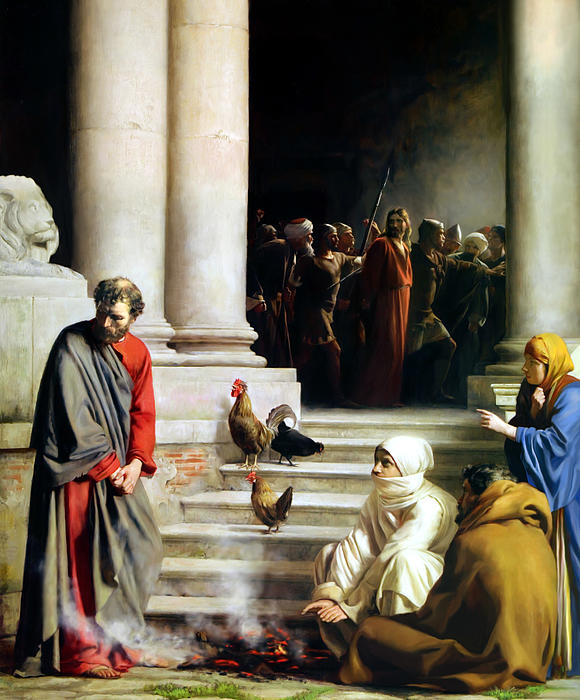
How do we respond when we suffer unjustly? We should learn from Jesus. He was a Man of Sorrows. No one has suffered more than Him. His close friend Peter denied Him.
Based on the example of Jesus we should take these seven actions.
- When someone hurts us we should include them (Mark 16:7)
- When someone hurts us we should speak well of them. Jesus still referred to him by his positive nickname, Peter the rock (Mark 16:7, Matt. 16:17-18).
- When someone hurts us we should pursue them. We cannot wait for them to come to us, we must go to them (Luke 24:34, Matt. 5:23-24, 18:15).
- When someone hurts us we should honor them (Luke 24:34, 1 Cor. 15:5).
- When someone hurts us we should serve them (In John 21 Jesus helped Peter with fishing and served him breakfast).
- When someone hurts us we should restore them (John 21).
- When someone hurts us we should forgive them. To fail to forgive is to minimize the blood of Jesus and maximize the work of Satan. The devil is an accuser (Rev. 12:10). When we refuse to forgive others we participate in Satan's darkness and open ourselves up to his evil (Eph. 4:26-27, Matt. 18:34).
How to Remove Bitterness
After the children of Israel passed through the Red Sea they became thirsty in the wilderness. They found water at Marah but it was too bitter to drink. The people complained to Moses who prayed to God. The Lord showed Moses a tree and when Moses threw it into the water the water became sweet (Exodus 15:22-25). The tree is a type of the cross. God here is foreshadowing the power of the cross to remove bitterness.
It is certainly true that the cross removes bitterness from eternity. Jesus described the rich man in Luke 16 tormented in the flame longing for just a drop of water from the tip of Lazarus's finger. What a dramatic contrast to those who through the power of the cross enter the New Jerusalem where the water of life in a pure river, clear as crystal, proceeds from the throne of God and of the Lamb (Rev. 22:1).
Not only does the cross remove bitterness from eternity, the cross also removes bitterness from this life. And since this event is after the Red Sea experince, a type of salvation, perhaps this is the best way to understand this passage. Life can get polluted with opinions, convictions, expectations, traditions, likes and dislikes. These impurities can rob us of joy when things don't go the way we want. The unpleasant result is bitterness. The solution is the cross where we die to our values, persuasions, comfort, and sense of right and wrong.
Are you cross-eyed?
Place the cross between you and every frustration. Don't focus on the problem, focus on your cross. As you become "cross-eyed" life's bitterness passes and life becomes sweet again.
The cross of Jesus Christ is two-sided. One side is for Jesus and the other is for His followers. Jesus died to take away our bitterness and give us a sweet eternity. We also must die on the cross in order to overcome life's bitterness and enjoy a sweet life now.
Will You Take Up Your Cross Today?
Following Jesus is not for everyone. All are welcome, but few are willing to make the necessary sacrifice. Jesus carried a cross and all genuine Christ-followers must do the same.

Jesus said to them all, "If anyone desires to come after Me, let him deny himself, take up his cross daily, and follow Me" (Luke 9:23). What exactly is the cross?
- THE CROSS IS VOLUNTARY: The cross is not when something bad happens to you (sickness, unemployment, etc). The cross is when you choose of your own free will to die to something. There is nothing passive about the cross, it is an active choice.
- THE CROSS IS PERSONAL: Each disciple must take up "his cross." What God is asking of you and me is different. We each have our own struggles and temptations to moritify.
- THE CROSS IS DAILY: How much easier Christianity would be if we only had to die to self once; but, following Jesus is a daily, moment by moment reality. Jesus said we have to voluntarily take up our personal cross everyday and choose to follow Him. This is the way of the Christian.
The Apostle Paul taught these same truths in Romans 12:1. Our sacrifice to God is to be
PERSONAL: "I beseech you therefore brethren by the mercies of God"
VOLUNTARY: "that you present your bodies"
DAILY: "a living sacrifice, holy, acceptable to God."
He's Indescribable
God is too big to describe. Often scripture piles words on top of one another to try to bring the full understanding. For example, Psalm 46:1 says, "God is our refuge and strength, a very present help in trouble."
- God is a help
- God is a present help
- God is a very present help in trouble
The Psalmist couldn't describe the greatness of God, can you?
Higher and Deeper with God through Worship
Moses went up on Mount Sinai and received both the Ten Commandments and the blueprints for the tabernacle. In so doing God gave both the law for man's obedience and grace for man's failure, for the tabernacle is a type of Jesus. The tabernacle, layed out in the shape of a cross, is how one draws near to God for forgiveness and restoration.

The first item the worshipper saw was the multi-colored gate. Blue is the color of heaven, purple is the color of royalty, and red is the color of blood. This of course showing that Jesus is a king who came from heaven and shed His blood for us.
Jesus said, "I am the door." The only way into the tabernacle was to pass through this entrance. Jesus said, "I am the Way, the Truth, and the Life, no one comes to the Father except through Me" (John 14:6).
One of the truly great worshippers in the Bible King David explains how to pass through this doorway. "Enter into His gates with thanksgiving, and into His courts with praise. Be thankful to Him, and bless His name" (Psalm 100:4).
Now in a very practical way, if you want to go deeper with God, begin in this manner. Observe these three acts of worship.
- BE THANKFUL TO HIM. Look around and identify your many blessings. Don't just be thankful for the gifts, but be thankful to God for those gifts.
- PRAISE HIM. Thankfulness is primarily for visible things, yet praise is for the invisible traits of God grasped by faith. Take a few moments to tell God how marvelous He is, enumerate His many wonderful qualities (true, kind, merciful, faithful, holy, forgiving, unchanging, faithful, good, almighty, etc).
- BLESS HIS NAME. In the Bible, names do more than identify, names express quality and nature. Thus, the names of God tell us about the essence of God. He is Father, Savior, Shepherd, King, Ancient of Days, Master, Emmanuel, Wonderful Counselor, Man of Sorrows, Captain of our salvation, Jehovah-Jireh (the Lord who provides), Comforter, Prince of Peace, I AM, etc.
Get started today in your journey toward God with thanksgiving and praise.
Honoring Law Enforcement

Jack Moore, pastor of First Baptist Church Fisherville TN, gave this timely message. Based on Romans 13:1-7,
- Everyone is to obey the authorities, 1a
- God has appointed all authorities, 1b
- To resist the authorities is to resist God, 2a
- Resisting authority brings judgment, 2b-4
- Chrisitans should set the example, 5-7
And if we don't honor law enforcement, Dr. Jerry Vines warns
- We will have anarchy in the culture
- We will have apostacy in the church.